Results — scale
Archive — the original J-space replication study
This is what the repository started as: replicating the J-space / global-workspace readout claim on open weights. That readout claim did not survive our controls — an informative null, preserved here with full rigor — and the project pivoted to the operator/operand finding on the main page. These pages are kept as-is.
Does the J-space exist at every scale, or emerge and sharpen with size? We fit the identical J-lens on Qwen3 1.7B and 8B (32B in progress) and compare per-layer metrics (reindexed to a 0–100 depth scale) and the paper's pass@k lens-quality eval.
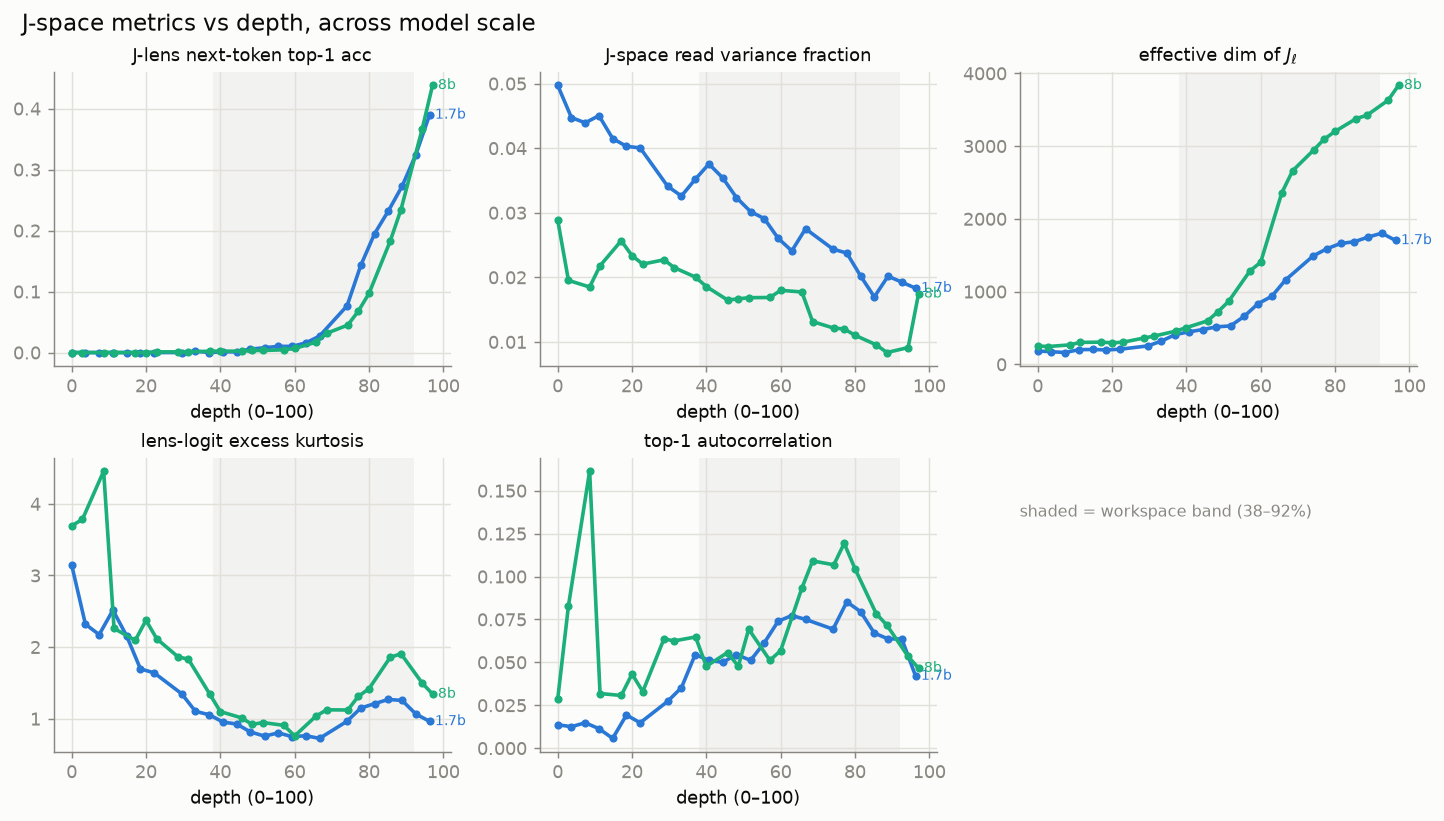
Per-layer metrics
The workspace band (38–92% depth) is shaded. Blue = 1.7B, green = 8B.
read_var_frac— the J-lens read directions hold a small, shrinking fraction of residual variance, and it shrinks further with scale: the 8B curve sits clearly below 1.7B (workspace mean 0.014 vs 0.027). The J-space becomes more concentrated / specialized as the model grows.top1_autocorr— readout persistence peaks inside the workspace band at both scales, the signature of content held across positions.jlens_top1— next-token accuracy stays near zero until the motor regime, then rises steeply toward the output, at both scales.eff_dimscales with model width (≈0.5·\(d_\text{model}\) at both sizes).
Lens quality (pass@k)
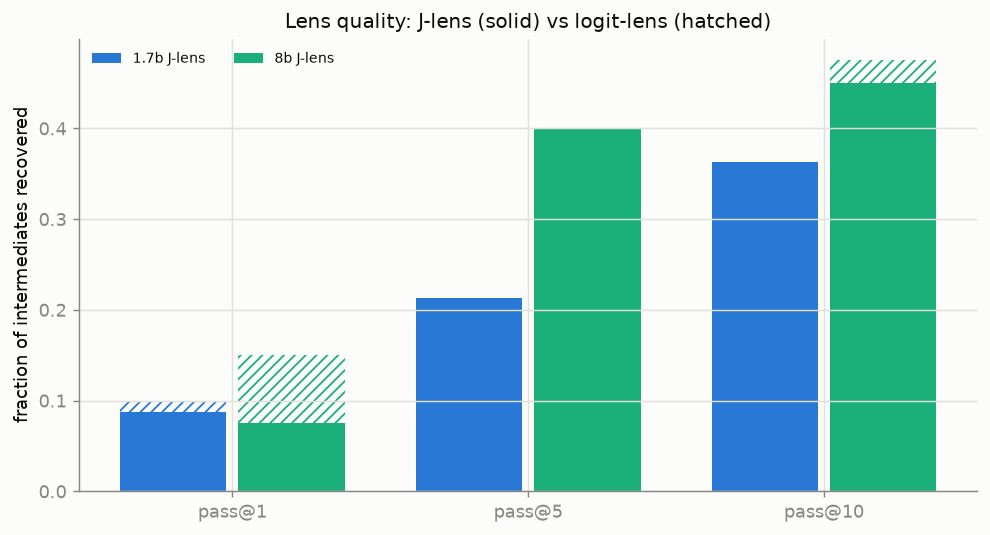
pass@k = fraction of hidden two-hop bridge entities recovered at lens rank ≤ k. Here the result is honest and nuanced: on our implementation the J-lens only ties the logit-lens at both 1.7B and 8B (at 8B the logit-lens is even marginally ahead on pass@1/@10). The strong J-lens ≫ logit-lens advantage the paper reports for Claude does not clearly reproduce on Qwen3 at these scales. Candidate reasons: small eval sample (40 items), a metric-detail difference from the paper, or an advantage that only appears at 32B. We report it as-is.
Quantization control (8B bf16 vs int8)
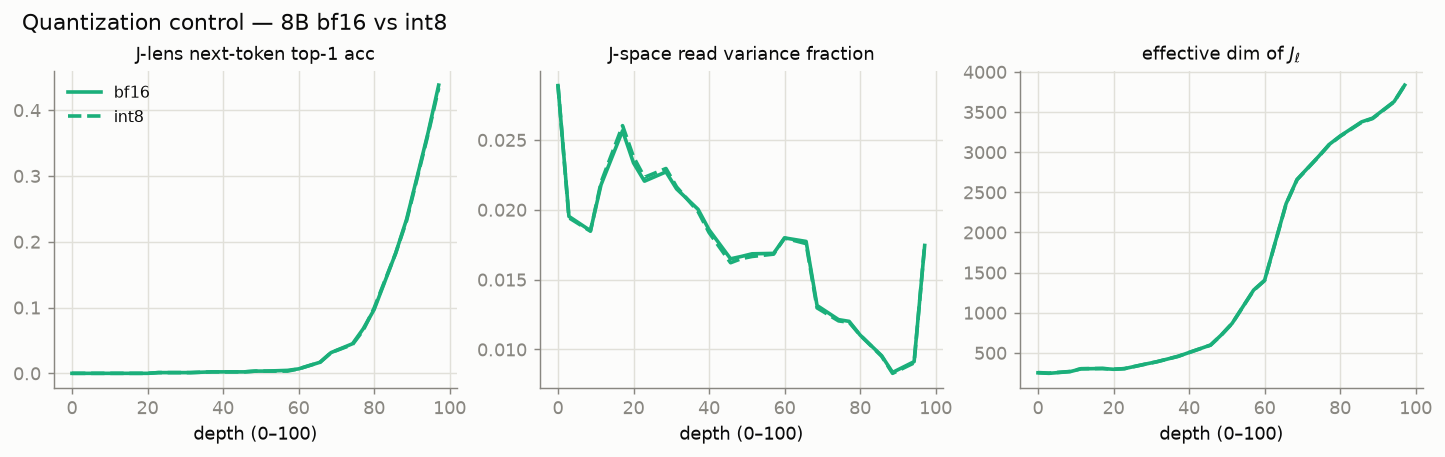
Because 32B is run in int8 (the 48 GB wall), we fit the 8B in both precisions and compare. int8 preserves the J-space almost exactly:
| metric | rel. diff (bf16 vs int8) | correlation |
|---|---|---|
jlens_top1 |
1.0% | 1.0000 |
read_var_frac |
0.8% | 0.9996 |
eff_dim |
0.2% | 1.0000 |
kurtosis |
2.4% | 0.9994 |
top1_autocorr |
6.0% | 0.9785 |
| causal workspace flip | 0.55 → 0.59 | — |
The same held at 1.7B (correlations 0.97–1.00). So the 32B-int8 results are trustworthy — the quantization confound is at the ~1–2% level on the structural metrics and negligible on the causal result.
Takeaway so far
Two dissociated tracks, both now with two scale points:
- Causal structure (see causal) is strong and sharpens with scale.
- Readout legibility (pass@k) is the weaker signal and does not open a gap over the logit-lens on Qwen3 yet.
In progress
32B (int8) is the third scale point; it will tell us whether the pass@k advantage finally emerges at large scale, and whether the causal sharpening continues.